Sovereign Access Gateway
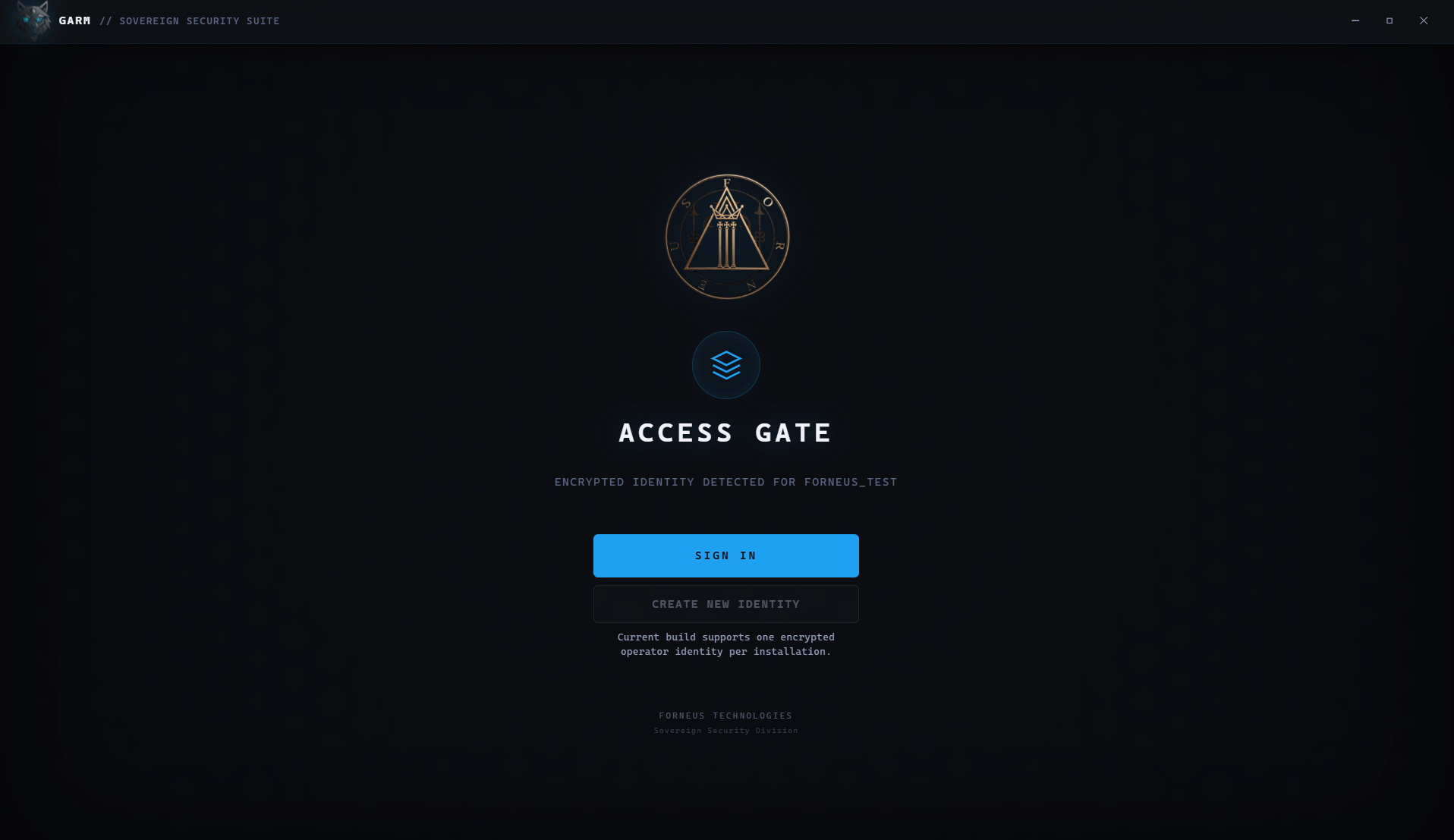
Multi-layered operator authentication panel. Verification loop binding digital session signatures with real-time biometric and hardware attestation to prevent unauthorized physical or network intrusions.

Neural RAM Vault & Micro-Hypervisor · Hardware-Level GPU-Accelerated Isolation
Engineered for HFT firms and defense contractors. GARM isolates critical applications in RAM and physically destroys compromised data in under 100 milliseconds. Hardware-level security that software cannot bypass.
GARM is a hardware-isolated Neural RAM Vault with a GPU-accelerated biometric hypervisor. FIPS 140-3 assessment pathway initiated Q4 2026. Planned pre-seed capital would fund FIPS compliance audits and early corporate pilot scaling.
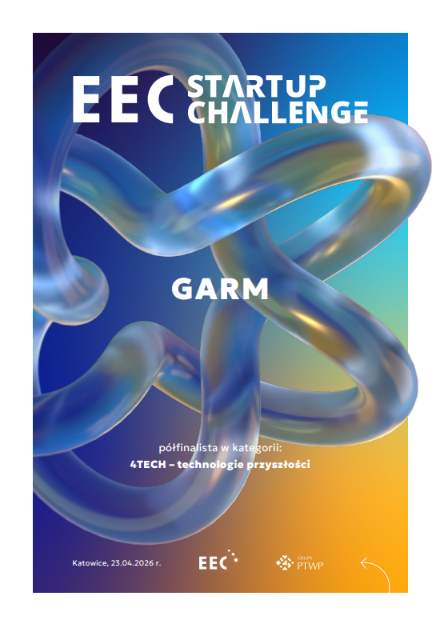
Request Brief →GARM was selected among the Top 80 European deep-tech startups at the European Economic Congress 2026 in Katowice — one of Europe's most prestigious technology innovation showcases.
The EEC Startup Review evaluates ventures across Europe on technical innovation, market potential, and execution quality. GARM's selection validates our approach to hardware-level AI security as a category-defining technology.
GARM is positioned for high-assurance local protection around sensitive data and critical workflows. The investor case is not a promise of invulnerability; it is a testable architecture built around local control, post-quantum design, hardware-bound access, and reduced cloud dependency.
Why GARM? The product thesis combines isolation, local AI monitoring, and volatile-memory workflows in one security layer. Why now? Breach costs, NIS2/DORA pressure, and post-quantum migration are pushing security decisions upward. Why this investment? The diligence question is whether GARM can turn this architecture into verified pilots, audits, and recurring security spend.
Four hardened subsystems forming a zero-trust perimeter around critical applications and data.
A hardware-level micro-hypervisor isolates dedicated memory pools with AES-256 encryption applied at the hardware boundary. Continuously randomizes memory layout using native memory primitives eliminating cold boot attacks, DMA exploits, and kernel-level memory scraping.
Renders the entire user interface exclusively in GPU VRAM via DirectX 12, bypassing standard OS compositing. The application is completely invisible to screen capture APIs, spyware, remote desktop tools, and shoulder surfing. Only the physical display output shows the UI.
Runs locally on NVIDIA GPUs to perform continuous 12ms face detection, eye tracking, and attention analysis. Keystroke stylometry creates a neural fingerprint unique to each authorized operator detecting unauthorized users even if they have valid credentials.
Volatile key clearing triggered by unauthorized faces, unknown USB devices, network anomalies, or manual dead-man switch. Cryptographic keys are zeroed, memory pools overwritten with noise, and volatile state irreversibly destroyed.
Institutional-grade resilience for banking and national security sectors.
Standard EDRs cause billion-dollar outages. GARM's Deep isolation acts as an insurance policy, maintaining data sovereignty even if the host OS is completely compromised.
Hardware-lock combined with an accelerometer trigger. If the device is violently yanked or stolen, encrypted sessions can be locked and volatile keys cleared under policy.
The vault is designed to reduce exposure to standard OS-level capture and inspection surfaces while keeping validation requirements explicit.
Cryptographic binding to unique silicon ID (TPM/HSM), preventing cloning, unauthorized migration, or execution on unrecognized hardware environments.
From biometric verification to emergency lockout, every step is protected at the hardware level.
Phased hardening schedule. Each phase extends the security perimeter.
Deploy hardware-level micro-hypervisor with native memory isolation. AES-256 encrypted RAM pools with continuous address space randomization. Cold boot and DMA attack mitigation.
Implement VRAM-exclusive rendering pipeline bypassing OS compositor. Anti-screen-capture hardening across all Windows compositing APIs. Secure UI overlay for operator authentication flows.
Deploy face tracking and keystroke stylometry on local NVIDIA GPUs. Build neural fingerprint database with continuous learning. Integrate rapid lockout triggers with biometric anomaly detection.
Central management dashboard for multi-node deployments. Policy engine for biometric thresholds and wipe conditions. Compliance documentation and audit logging for FIPS 140-2 Level 3.
Every major data breach in history shares a common thread: conventional storage trusts the wrong layers. GARM trusts nothing.
Every layer operates independently. Breaching one grants access to nothing. No cloud. No updates. No trust.
Live snapshots from GARM's sandboxed micro-hypervisor and encrypted vault system. Fully functional builds verified in our local lab environments.
Multi-layered operator authentication panel. Verification loop binding digital session signatures with real-time biometric and hardware attestation to prevent unauthorized physical or network intrusions.
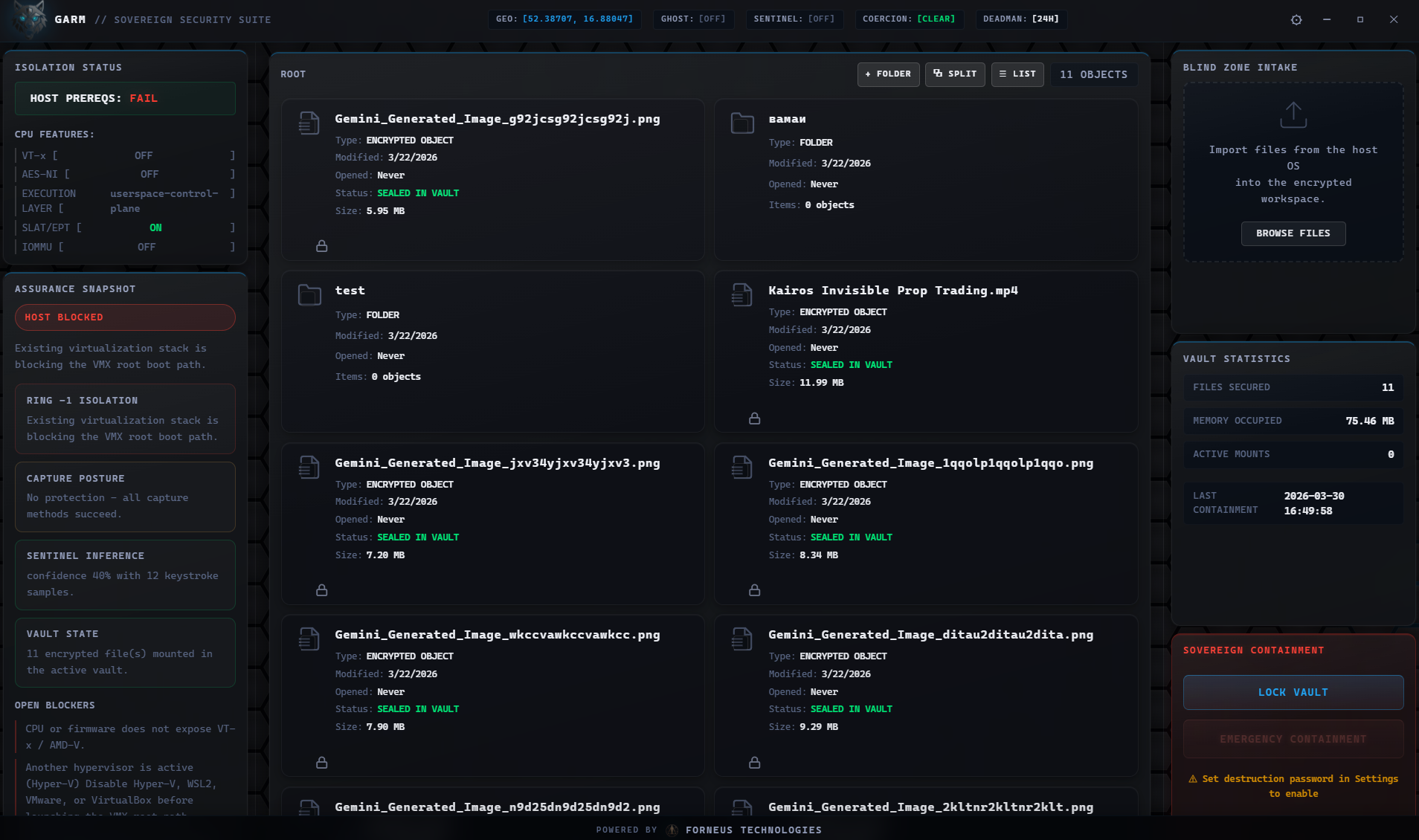
RAM-only virtual file system explorer showing active encrypted objects sealed in secure vaults. Dynamic stats monitor occupies memory footprint in real-time, minimizing recoverable residue on physical storage.
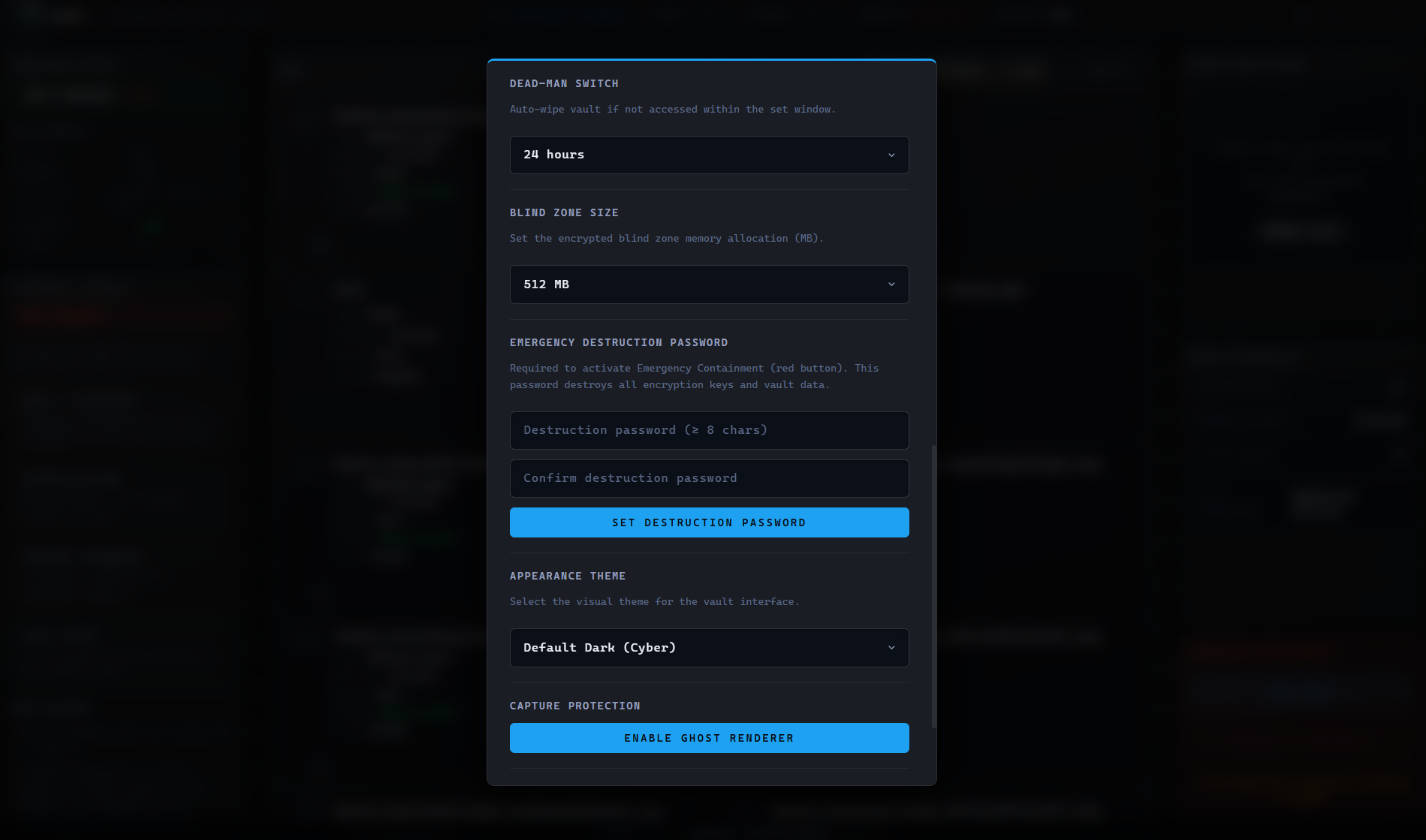
Security settings interface for session-watchdog timing, emergency lockout passwords, and Ghost Renderer settings. Independent system-level watchdogs prevent unauthorized memory dumping.
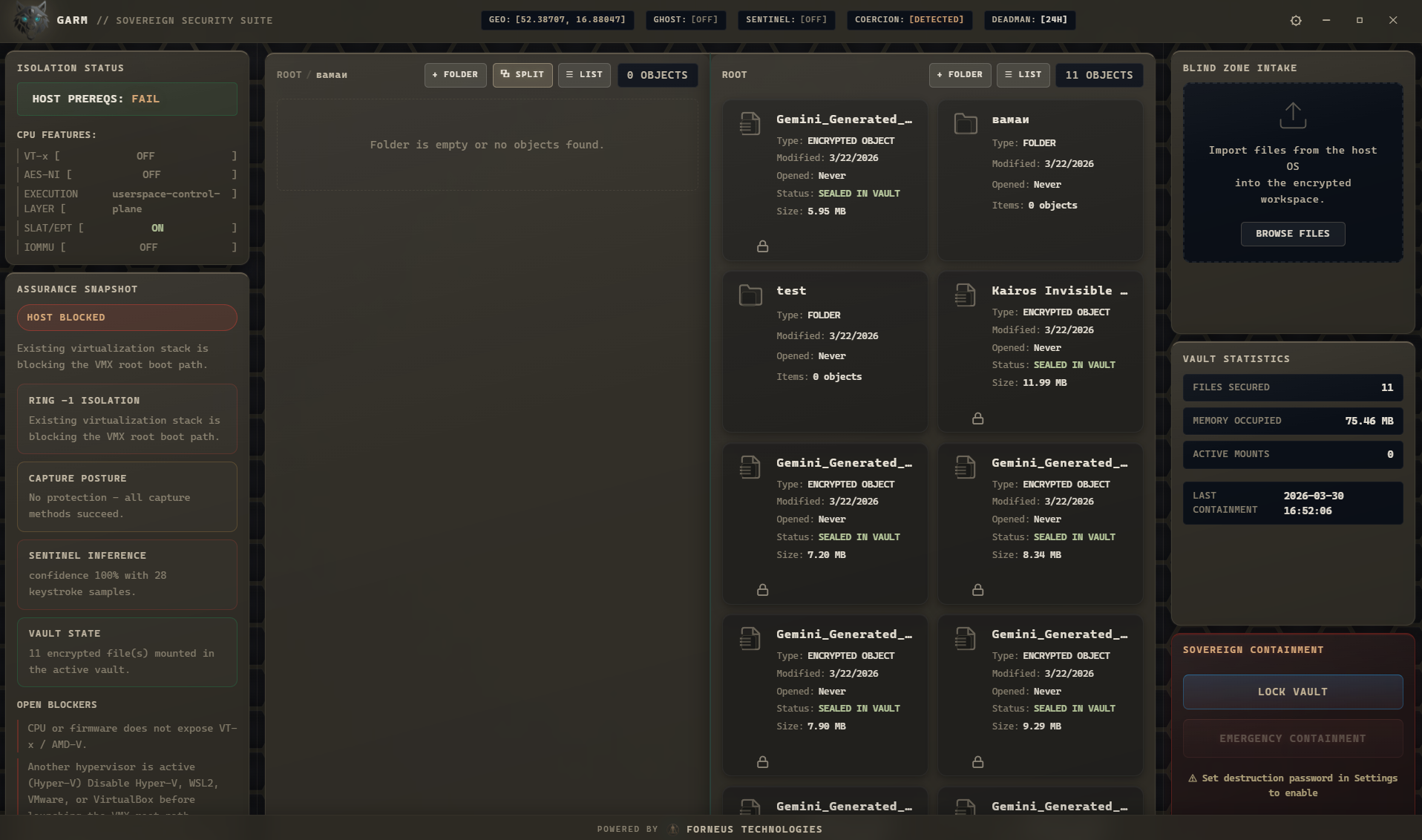
Active folder inspection inside GARM's sandboxed environment. File contents are isolated using micro-hypervisor primitives, preventing cross-domain memory exposure and zero-day host escalation.
GARM is available exclusively to defense contractors and HFT trading desks.
Request Security ClearanceIBM Cost of a Data Breach Report GARM makes breaches extractionless.
Standard operating systems (iOS, Android, Windows) are bloated with telemetrics and backdoors. A single zero-click exploit or malicious physical access at an airport border can extract cryptographic keys, corporate secrets, and personal communications.
True Physical Segregation. GARM boots from a integrity-verified, read-only external drive. It minimizes host-machine trace under the proposed operating model. If physically seized, the plausible deniability protocol activates, making the hidden encrypted volumes difficult to distinguish from random noise under the proposed deniability model.
Traveling with sensitive data across hostile borders relies on "hiding" folders or using commercial VPNs that log traffic. State-sponsored actors possess forensic tools that map commercial encryption structures in minutes.
Anti-Forensic Architecture. GARM routes all traffic through a multi-hop, heavily obfuscated Tor/I2P overlay. "Panic Mode" wipes the decryption keys from RAM instantly upon device removal or a targeted hotkey, permanently destroying access to the secure container.
Client data protection at the hardware level. Hardware vault ensures even compromised OS cannot expose sensitive financial records. Regulatory compliance built-in.
Classified document storage with VRAM rendering data never touches RAM. Anti-forensics, GPU-assisted decryption, rapid lockout workflows, and hardware-bound access controls.
Protect trade secrets, source code, R&D data. Plausible deniability mode. Steganographic storage. Zero cloud dependency full sovereign control.
Field-resilient data protection for controlled environments. Works offline, supports degraded-connectivity operations, and can pair hardware tamper detection with policy-based lockout.
Organizations requiring enterprise-grade data protection can secure prioritized deployment mapping by submitting a formal partnership document. Demonstrated institutional traction directly dictates feature prioritization and accelerates defense/NVIDIA tech grant validation. We accept three tiers of formal partnership documentation:
Official statement of intent to become a primary pilot client upon release. Proves direct market demand and accelerates scale-up. Non-binding but highly influential.
Official endorsement of our R&D value for the ecosystem. Crucial for securing top-tier defense tech grants by confirming expert backing.
📧 oleksandr.l@forneus.io
Please send official documents on agency/company letterhead through proper administrative
channels.
Include: Organization name, sensitivity classification, deployment scale.
Every submitted document significantly increases our probability
of
securing deep-tech funding, accelerating the delivery pipeline for your division.
// SECURITY RISK SHOULD BE QUANTIFIED, PRIORITIZED, AND REDUCED BEFORE SCALE.
GARM is the security backbone every Forneus Technologies module depends on its vault for data integrity.
Securely provisions API keys, broker credentials, and strategy parameters to the trading engine. All credentials remain encrypted until the moment of execution.
Manages identity verification, encryption key lifecycle, and end-to-end handshake protocols for PHANES' zero-knowledge messaging layer.
Bi-directional trust: Authenticator validates user identity; GARM stores the cryptographic proof and manages session tokens across all modules.
Hardware-isolated neural RAM vault for regulated credentials, secrets, and high-risk AI sessions. Founded in 2025, currently bootstrapped, operating in a founder-funded, pre-institutional stage. The figures below are target budgets and milestone assumptions for a first priced round, not announced financing.
Endpoint DLP, hardware security modules, hardware root of trust, and secrets-management infrastructure driven by NIS2, DORA, and post-quantum migration.
EU finance, defense supply chain, critical manufacturing, legal, and cloud-sensitive enterprise accounts requiring local key custody and auditability.
120-180 enterprise contracts in 36 months after seed at $80K-$100K ARR, excluding cross-sell into KAIROS and Authenticator.
EU NIS2 18-sector cybersecurity scope; DORA financial ICT resilience; NIST FIPS 203/204/205 post-quantum standards. SOM is calculated as reachable revenue/bookings from a narrow initial segment, not as a percentage fantasy of the whole market.
GARM sits in a forced security-refresh cycle: NIS2 expands board accountability, DORA pressures financial ICT controls, and NIST post-quantum standards turn cryptographic migration from theory into procurement planning.
The European Commission defines NIS2 as a unified cybersecurity framework across 18 critical sectors.
NIST finalized FIPS 203, 204, and 205 in August 2024, giving buyers a concrete migration target.
SOM is modeled as regulated EU enterprise accounts with secrets, keys, and identity risk, not the full cybersecurity market.
Core vault architecture, biometric access concept, micro-hypervisor boundary, and product proof assets completed without external capital.
Threat model, enterprise beta packaging, secure build pipeline, and first controlled deployments with design partners.
ISO 27001 implementation plan, FIPS 140-3 pre-assessment, penetration-testing scope, and DORA-aligned audit evidence.
5-10 regulated pilots, hardened admin console, SLAs, and integrations with Authenticator and KAIROS.
General availability, paid regulated customers, certification progress, and Series A readiness from renewal and usage telemetry.
We share technical evidence, roadmap assumptions, and funding use-of-proceeds under qualified investor or strategic partner access.
Request Access// Technology context
GARM is a cybersecurity and trust-control platform for organizations that need secure access, protected secrets, identity assurance and defensible evidence across regulated operations.
A staged path for threat intelligence and response, sequenced around validation, trust controls, partner readiness, and capital discipline.
Security trust path keeps the next release decision tied to evidence rather than broad unfocused spending.